TURQUOISE
In Indian folklore it is said that there was once a chief with turquoise colored skin. One day he was running from his enemies in the hot desert. Whenever he stopped to rest, his perspiration ran onto the ground, collected in rocks and became turquoise.
There are many legends about Turquoise; The Pima consider it to bring good fortune and strength and that it helped overcome illness. The Zuni believe that blue turquoise was male and of the sky and green turquoise was female and of the earth. Pueblo Indians thought that its color was stolen from the sky. In Hopi legend the lizard who travels between the above and the below, excretes turquoise and that the stone can hold back floods. The Apache felt that turquoise on a gun or bow made it shoot straight. The Navajo consider it as good fortune to wear and believe it could appease the Wind Spirit.
Man, from the earliest times, has considered the adornment of his person to be as necessary as food and shelter. The Indians of the Southwest are no exception. They have loved fine jewelry, esteemed it as wealth, and worn it profusely. Today the use of Indian jewelry has spread far beyond its original boundaries and its appreciation has become world-wide.
Concho belts are one of the most striking accessories of Indian jewelry.
Individuality and authenticity are what make Indian jewelry valuable. Today's craftsmen cut and shape turquoise, shell and other stone by much the same methods as their ancestors used to do.
Southwest Indians today are perhaps best known for the beauty and variety of their jewelry. Not only is it prized by the collector, but also by the Indian him or herself. Jewelry is considered as wealth and any ceremonial occasion is used to display it. One of the most striking features of a dance is the quantity and variety of jewelry worn by the dancers.
|
INDIAN WORK
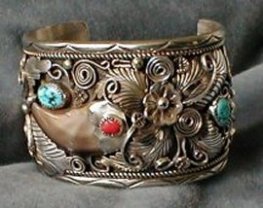
Navajo work is usually bold in design. The Navajo silversmith tends to pick a stone and build around it. Some will do a simple sterling braid, while others will do elaborate feathers, leaves, flowers, scrolls, etc. The Navajo do some inlay work, however, most pieces tend to concentrate on a single or several high quality stones along with the silver work.
Zuni Pueblo work is obtained by us from the Zuni Pueblo in New Mexico. The Zuni people are known for their delicate, intricate work with stones. They spend hours cutting down stones into small needlepoint and "petit point" shapes as well as doing intricate inlay and channel inlay work. The inlay work is rather like a mosaic where all pieces have been cut to fit together and form a pattern or design. The Zuni are also well known for their hand carved "fetish" necklaces. These are necklaces containing spiritual animals such as bears, turtles, wolves, foxes, etc. which are believed to have the power to bring you strength, heal, and generally guide you to a better life when the fetishes are properly cared for.
The Santo Domingo Pueblo Indians of New Mexico are famous for their "heishe" work, nugget necklaces, and shell earrings. They tend to work strictly with stone and shell using very little if any silver in their pieces. Many of the necklaces are wrapped in "sinew" and do not contain clasps or openings. Santo Domingo pieces are very classic in style and remind you of jewelry found in Anasazi sites, as there was no silversmithing done on those pieces as well.
The Hopi Pueblo Indians of Arizona do a style which is very unique and very much their own. It is called overlay work. Two pieces of silver are used in each piece. A design is cut into one piece and is then overlayed over another piece of silver. Important symbols such as kachinas, rain, corn, water, kokopellis, and prayer feathers are but a few of the many designs they use. Most Hopi jewelry is void of any stones since the concentration is on the very "clean" stylized silver work itself. All of our jewelry is handmade by Native Americans using only sterling silver and the highest grade of turquoise, shell and native stone.
Indian Symbols and Their Meanings
Butterfly -- Everlasting life
Sun -- Happiness
Arrowhead -- Alertness
Bird -- Carefree and lighthearted qualities
Bear Claw -- Good luck, good omen, protection of the Gods
Thunderbird -- The sacred bearer of unlimited happiness
Sterling silver is used in fine Indian jewelry and can be durable and beautiful, but it can break when bent back and forth. Silver will also tarnish, and may be maintained with a jeweler's polishing cloth. Do not use abrasive or chemical cleaners.
Turquoise is a fairly hard stone, but is brittle and can be broken! Avoid crushing or striking your jewelry. Dealers will not warranty stones from breakage. Be cautious and you will have few problems.
In time turquoise will absorb skin oils, dirt, soap, and chemicals. Please avoid contact with these.
Immersing inlaid stones and shells into any liquid will weaken or dissolve the adhesive behind them and may loosen the stones.
You can avoid problems with bracelets by learning to put them on properly (slide them on at the side of your wrist). Avoid bending your bracelet back and forth. Not only will you eventually break the bracelet, but you may dislodge the stone(s).
Exercise a certain amount of care and your jewelry will give you years of enjoyment and pleasure.
A Zuni Fetish is an animal, bird or figure hand carved from stone, shell, antler, wood or other natural materials. Fetishes were first carved as "hunting" fetishes. When taken on a hunting expedition they would ensure a plentiful and successful hunt. Each fetish is believed to have a spirit within. If treated and taken care of properly the fetish will help guide you on the right path of life. Certain fetishes have special powers. The bear represents strength, the turtle long life and the horse has innate healing powers. When you purchase or are given a fetish it is your responsibility to care for it with the proper respect it deserves. Fetishes are believed to feed on corn meal, so don't neglect to feed your fetish. "Offerings" are often attached to the fetish by the artist, however you may make your own "offerings" to them by attaching a small stone or feather adornment. It will be greatly appreciated and you will be rewarded with the healing or strength you desire. We cannot guarantee that a fetish will change your life, but in our many years of experience we have seen many astonishing changes in peoples lives as a result of their belief in the fetish's powers. Our fetishes are Zuni carved unless otherwise noted, out of a variety of stone and shell. Prices will vary depending on detail, artist and the stone used. Also, some animals are not carved as often as others and will consequently cost a little more. With your fetish you will receive a description of the stone used, what the animal or figure represents and instructions on care and feeding of your new found friend.
|